Hashing Techniques in Data Structures
1. What is Hashing?
Definition: Hashing is a technique used to map large data sets into smaller tables using a hash function that generates an index.

Real Time Biotechnology Usage: Used in genomic databases, DNA indexing systems, protein sequence search systems like BLAST.
/* Basic Hash Table Implementation */
#include
#define SIZE 10
int hashTable[SIZE];

int hash(int key){
    return key % SIZE;
}

void insert(int key){
    int index = hash(key);
    hashTable[index] = key;
}

int main(){
    insert(25);
    insert(35);
    return 0;
}
2. Division Method
Definition: h(k) = k mod m

| Element |
Formula |
Index |
Collision |
| 12 | 12 % 10 | 2 | No |
| 22 | 22 % 10 | 2 | Yes |
| 32 | 32 % 10 | 2 | Yes |
| 45 | 45 % 10 | 5 | No |
| 55 | 55 % 10 | 5 | Yes |
| 65 | 65 % 10 | 5 | Yes |
| 78 | 78 % 10 | 8 | No |
| 88 | 88 % 10 | 8 | Yes |
| 99 | 99 % 10 | 9 | No |
| 19 | 19 % 10 | 9 | Yes |
Biotechnology Usage: Used in DNA fragment storage systems and genome indexing.
#include
#define SIZE 10
int table[SIZE];

int hash(int key){
    return key % SIZE;
}

void insert(int key){
    int index = hash(key);
    while(table[index] != 0){
        index = (index + 1) % SIZE;
    }
    table[index] = key;
}
3. Mid-Square Method
Definition: Square the key and extract middle digits.
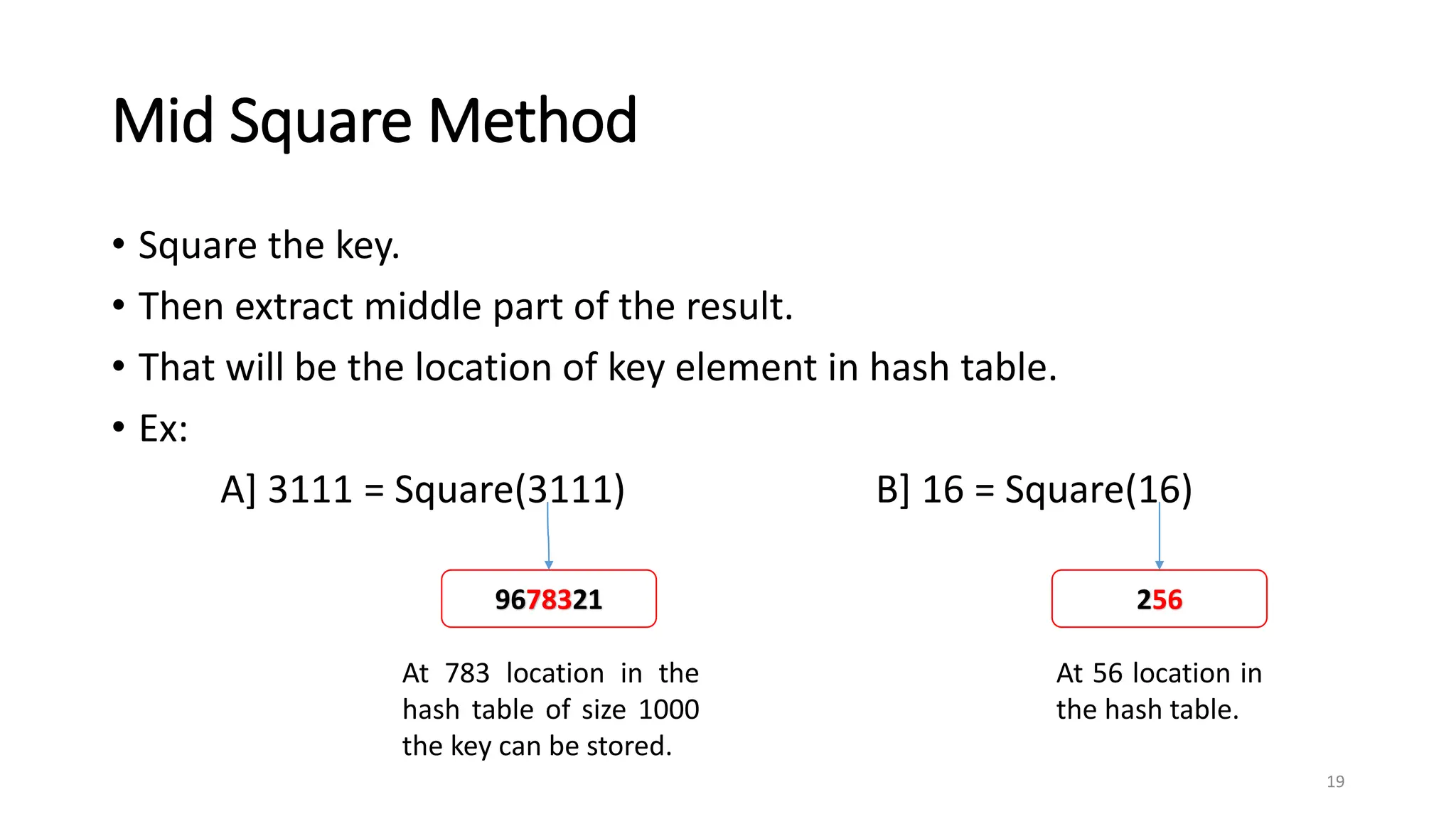
| Element | Formula | Index | Collision |
|---|
| 11 | 11²=121 → 2 | 2 | No |
| 21 | 21²=441 → 4 | 4 | No |
| 31 | 31²=961 → 6 | 6 | No |
| 41 | 41²=1681 → 8 | 8 | No |
| 51 | 51²=2601 → 0 | 0 | No |
| 61 | 61²=3721 → 2 | 2 | Yes |
| 71 | 71²=5041 → 4 | 4 | Yes |
| 81 | 81²=6561 → 6 | 6 | Yes |
| 91 | 91²=8281 → 8 | 8 | Yes |
| 13 | 13²=169 → 6 | 6 | Yes |
Biotechnology Usage: Used in molecular sequence indexing.
int hash(int key){
    int square = key * key;
    return (square/10) % 10;
}
4. Folded Method
Definition: Split key into parts and sum them.

| Element | Formula | Index | Collision |
|---|
| 1234 | 12+34=46 →6 | 6 | No |
| 2345 | 23+45=68 →8 | 8 | No |
| 3456 | 34+56=90 →0 | 0 | No |
| 4567 | 45+67=112 →2 | 2 | No |
| 5678 | 56+78=134 →4 | 4 | No |
| 6789 | 67+89=156 →6 | 6 | Yes |
| 7890 | 78+90=168 →8 | 8 | Yes |
| 8901 | 89+01=90 →0 | 0 | Yes |
| 9012 | 90+12=102 →2 | 2 | Yes |
| 1122 | 11+22=33 →3 | 3 | No |
Biotechnology Usage: Used in chromosome ID mapping systems.
int hash(int key){
    int part1 = key / 100;
    int part2 = key % 100;
    return (part1 + part2) % 10;
}
5. Multiplication Method
Definition: h(k) = floor(m (kA mod 1))
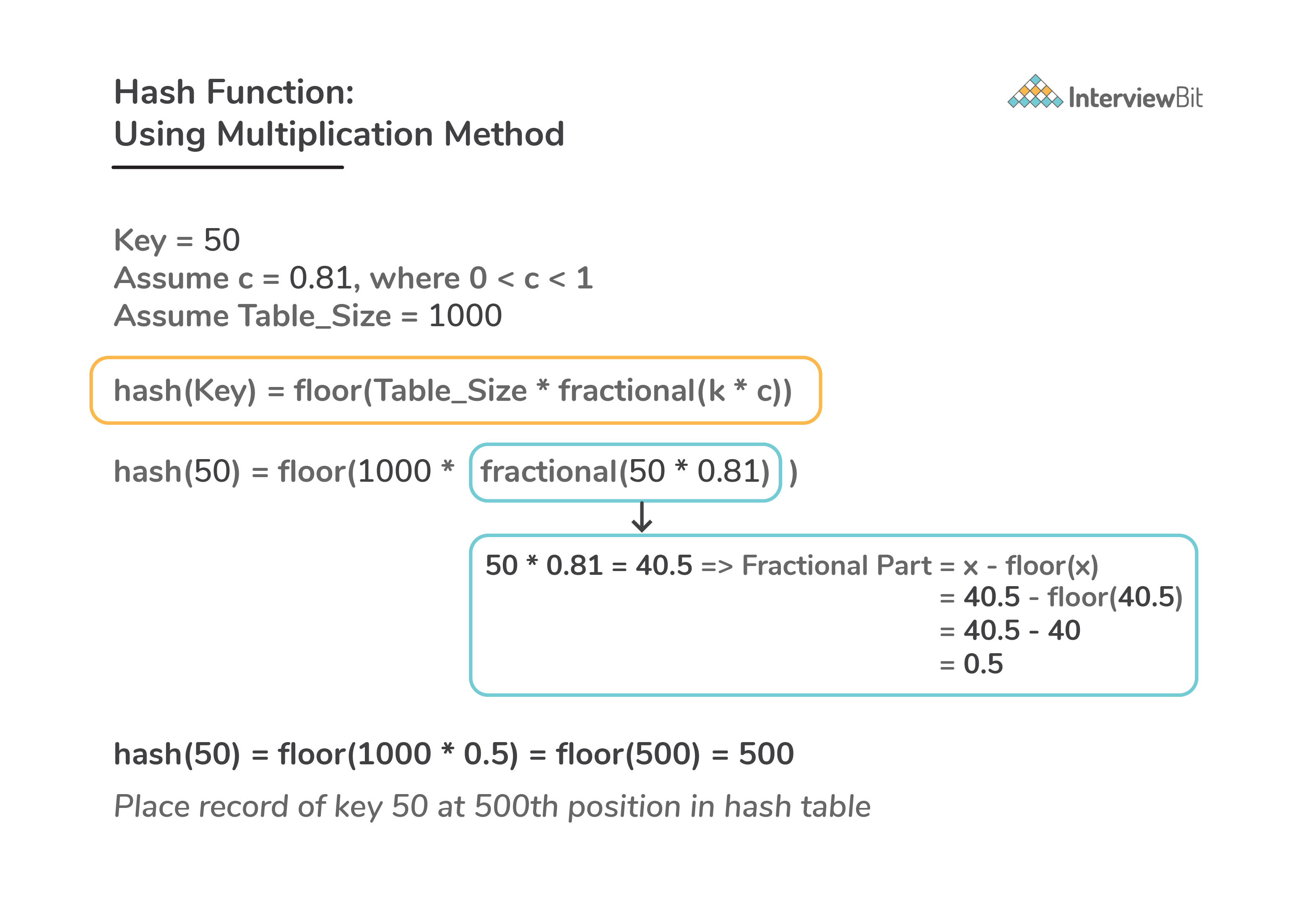
| Element | Formula | Index | Collision |
|---|
| 10 | floor(10*(10*0.618 mod1)) | 8 | No |
| 20 | floor(10*(20*0.618 mod1)) | 6 | No |
| 30 | floor(10*(30*0.618 mod1)) | 4 | No |
| 40 | floor(10*(40*0.618 mod1)) | 2 | No |
| 50 | floor(10*(50*0.618 mod1)) | 0 | No |
| 60 | floor(10*(60*0.618 mod1)) | 8 | Yes |
| 70 | floor(10*(70*0.618 mod1)) | 6 | Yes |
| 80 | floor(10*(80*0.618 mod1)) | 4 | Yes |
| 90 | floor(10*(90*0.618 mod1)) | 2 | Yes |
| 100 | floor(10*(100*0.618 mod1)) | 0 | Yes |
Biotechnology Usage: Used in high-speed genome indexing and drug discovery databases.
int hash(int key){
    float A = 0.618;
    return (int)(10 * ((key * A) - (int)(key * A)));
}
Theoretical Overview: How to Overcome Collisions
Collision Resolution Techniques:
- 1. Linear Probing: Find next empty slot sequentially.
- 2. Quadratic Probing: Use quadratic formula for new index.
- 3. Double Hashing: Use second hash function.
- 4. Chaining: Use linked list at each index.
- 5. Rehashing: Increase table size and recompute.
In biotechnology systems like DNA sequence databases and protein indexing, chaining and double hashing are widely used to efficiently manage large biological datasets.